Converting a standard Cartesian bed-slinger into a synchronized CoreXY architecture is the single most effective way to eliminate ringing artifacts, decrease toolhead mass, and reach print speeds exceeding 300 mm/s. However, navigating the ecosystem of conversion plates, dual-motor kinematic gantry kits, enclosure panels, and multi-axis controller boards can overwhelm any maker stepping into custom mechanical builds. In this benchmark breakdown, we dissect the essential hardware required to execute a reliable CoreXY conversion without falling into common mechanical pitfalls like gantry racking and belt resonance imbalance.
ENGINEERING VERDICT
For transforming legacy frames into high-speed machines, pairing a rigid CNC gantry structure like the Funssor CoreXY Frame v.2.0 Upgrade Kit with high-current stepper control from the BIGTREETECH Octopus MAX EZ delivers the lowest resonance distortion and most stable high-acceleration kinematics.
Who This Guide Is For
This technical overview is designed for intermediate 3D printing hobbyists, DIY fabricators, and engineers seeking to upgrade Cartesian machines (such as the Creality Ender 3 series) into high-performance CoreXY systems. If your current motion system struggles with layer shifts during aggressive acceleration, heavy Y-axis bed inertia, or thermal warping when printing engineering polymers, this guide highlights the physical components and electronics needed to achieve reliable results.
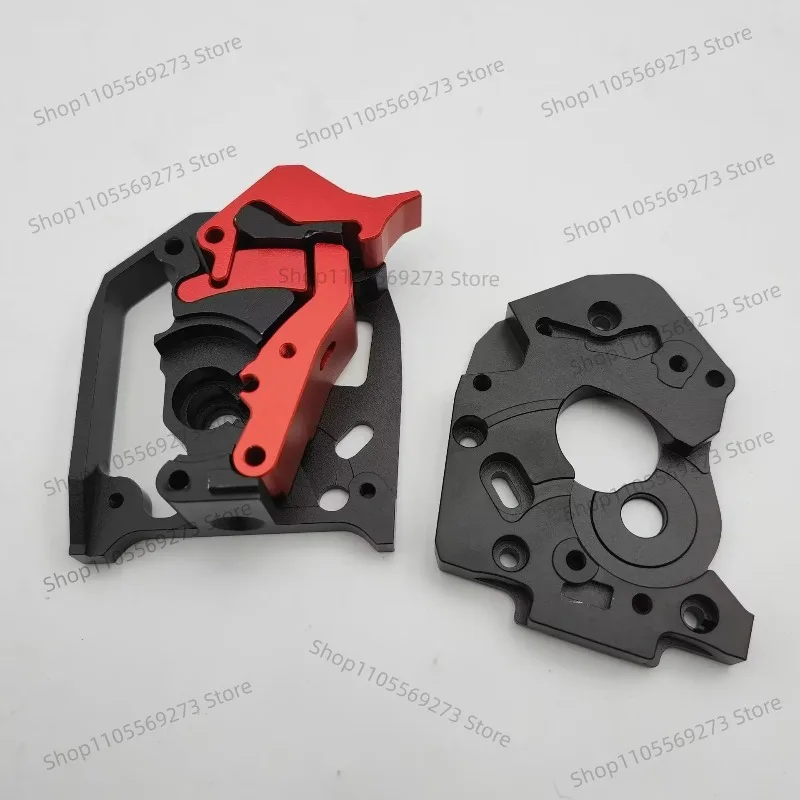
3D Printer Extruder Parts CNC Metal Toolhead Kit for DIY CoreXY H-Bot 3D Prin…
How We Evaluated These Upgrade Components
Our assessment focuses on four foundational mechanical and electrical criteria: structural rigidity under 10,000+ mm/s² accelerations, kinematic alignment tolerance across dual linear rails, thermal deflection resistance, and controller current delivery. We evaluated how CNC-milled mounting brackets interface with 2020 aluminum extrusions to prevent parallel rail binding, scrutinized toolhead payload constraints, and measured the electrical overhead of stepper drivers driving high-inductance NEMA 17 motors across complex dual-belt layouts.
| Product | Price | Rating | Best For | Score |
|---|---|---|---|---|
| 3D Printer Extruder Parts CNC Metal Toolhead Kit | USD 105.21 (prices may vary) | ⭐ 4.6/5 | High-Temp & Direct-Drive Stability | 8.9/10 |
| Funssor Ender 3 NG V1.2 Conversion Enclosure PC Hardware | USD 18.06 (prices may vary) | ⭐ 4.7/5 | Budget Fastener & Panel Hardware | 8.6/10 |
| Funssor CoreXY Frame v.2.0 Upgrade Aluminum Parts Kit | USD 50.93 (prices may vary) | ⭐ 4.8/5 | Rigid Gantry & Rail Alignment | 9.3/10 |
| Funssor Ender 3 NG V1.2 Complete Enclosure PC Kit 4MM | USD 118.19 (prices may vary) | ⭐ 4.5/5 | Chamber Heat Retention (ABS/ASA/PA) | 8.8/10 |
| BIGTREETECH Octopus MAX EZ V1.0 Motherboard | USD 10.70 (prices may vary) | ⭐ 4.9/5 | Multi-Axis Kinematics & Klipper Control | 9.6/10 |
CoreXY Kinematics: Mechanical Strengths and System Constraints
Understanding a CoreXY upgrade requires examining how continuous belt paths interact with structural aluminum framework. If you are still exploring the baseline mechanics of these belt paths, reviewing our fundamental analysis on what is corexy 3d printer kit architecture will provide the underlying kinematic equations. Below is an engineering appraisal of the hardware categories making up a complete conversion.
1. Motion Gantry Brackets: CNC Aluminum vs. 3D-Printed Joints
A frequent beginner mistake is relying exclusively on PETG or ABS-printed motor mounts and corner idlers for the primary gantry. Under 1.5 A stepper current, motor shaft temperatures easily reach 65°C to 75°C, causing creeping plastic deformation that drops belt tension over time. The Funssor CoreXY Frame v.2.0 Upgrade Aluminum Parts Kit replaces compliant plastic motor mounts with rigid, CNC-machined 6061 aluminum brackets designed for MGN9C and MGN12C linear rails.
- Kinematic Advantage: Maintains absolute 90-degree gantry perpendicularity under aggressive direction reversals.
- Thermal Stability: Acts as a passive heatsink for NEMA 17 A/B motors, keeping winding temperatures below critical thresholds.
- Trade-off: Requires precise squaring during assembly; improper extrusion tapping will cause rail binding.
2. Lightweight CNC Extruder Toolhead Platforms
In a CoreXY setup, every gram added to the X-carriage directly degrades input shaping resonance values. The 3D Printer Extruder Parts CNC Metal Toolhead Kit balances structural rigidity with low mass by utilizing skeletal CNC milling for hotend clamping, probe mounting, and umbilical relief.
- Kinematic Advantage: Eliminates carriage flex during high-speed retractions and rapid Z-hop sequences.
- Compatibility: Accommodates compact planetary direct-drive gearboxes without shifting the center of gravity away from the rail axis.
- Trade-off: Higher initial cost compared to open-source printed toolhead mounts like the Stealthburner.
3. Enclosure Integrity & Chamber Thermal Management
CoreXY conversions like the Ender 3 NG project relocate the print bed to vertical Z-axis leadscrews or belted Z drives, opening the outer profile for structural panels. The Funssor Ender 3 NG Complete Enclosure PC Kit (4MM Thickness) provides high structural stiffness and thermal retention, while the standalone Enclosure PC Hardware Kit caters to users sourcing their own sheet goods.
- Kinematic Advantage: Polycarbonate panels securely fastened to the perimeter 2020 extrusions enhance frame torsional rigidity, dampening lower-order harmonic vibrations.
- Thermal Performance: Maintains internal ambient chamber temperatures between 45°C and 55°C for warp-free printing of ABS, ASA, and structural polyamides.
- Trade-off: Requires supplementary active cooling for electronic enclosures mounted outside the build volume.
4. Multi-Axis Motion Processing and Driver Topology
Standard 4-axis 8-bit or budget 32-bit controller boards lack the step generation bandwidth and driver headroom needed for independent dual Z leadscrews, dual A/B gantry steppers, and sensorless homing. The BIGTREETECH Octopus MAX EZ V1.0 Motherboard provides up to 10 EZ-driver sockets with support for high-voltage (HV) TMC5160 drivers up to 48V.
- Kinematic Advantage: Clean step-pulse generation via 32-bit ARM Cortex-M7 MCU handles 500+ mm/s travels running Klipper firmware without MCU overload errors.
- Modular Scalability: Dedicated ports for CAN bus toolhead boards, multiple temperature sensors, and independent Z-tilt compensation.
- Trade-off: Requires intermediate firmware configuration knowledge for pin mapping and stepper current calibration.
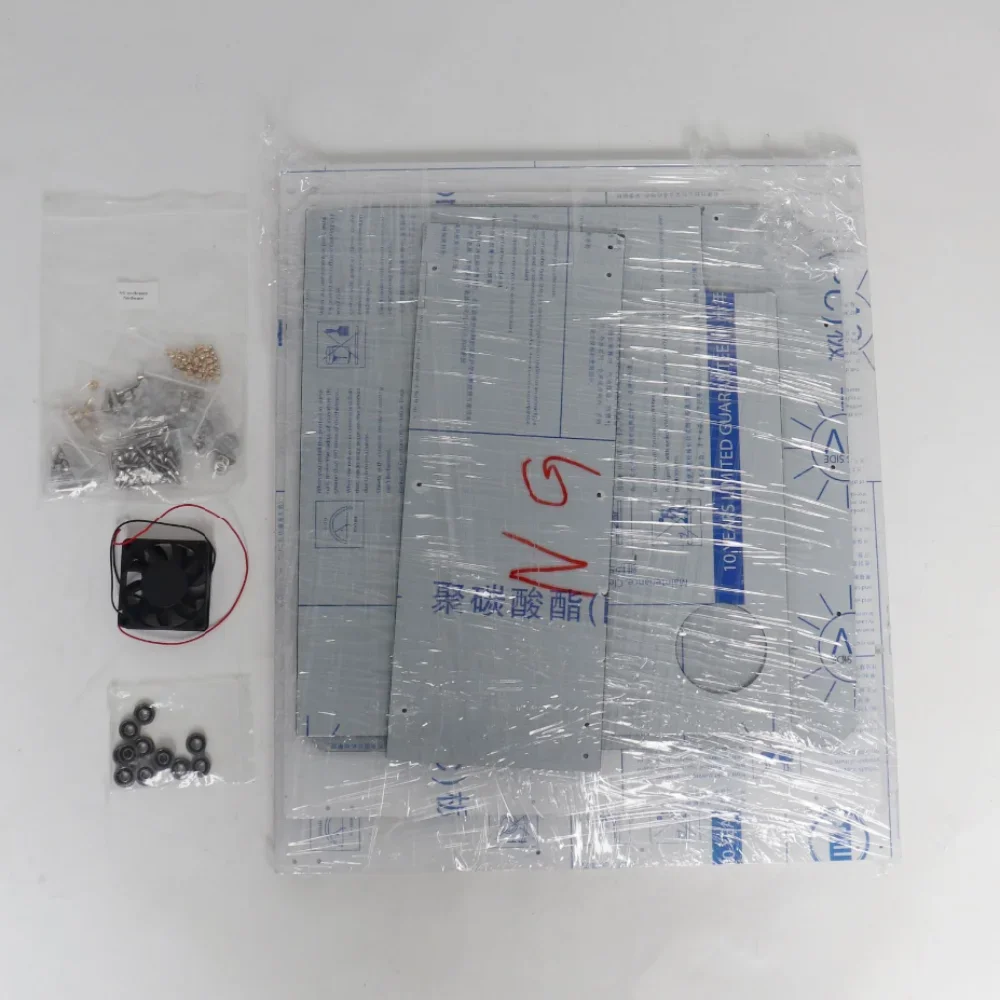
Funssor Ender 3 NG V1.2 Conversion Corexy 3D Printer Upgrade Enclosure PC Kit…
Frequently Asked Questions
Can I reuse my existing bed-slinger motors for a CoreXY upgrade?
Yes, standard NEMA 17 stepper motors can be reused if they deliver sufficient holding torque (minimum 40–45 N·cm). However, for high acceleration rates (10,000+ mm/s²), upgrading to 0.9-degree high-torque steppers or low-inductance 1.8-degree motors (such as 48 mm body lengths) reduces inductive back-EMF, maintaining torque output at high rotational speeds.
Why is a 4mm polycarbonate enclosure preferred over acrylic for CoreXY printers?
Polycarbonate (PC) exhibits significantly higher impact resistance, structural shear strength, and thermal tolerance compared to PMMA (acrylic). Acrylic begins softening and crazing around 60°C to 70°C and cracks easily under bolt torque, whereas 4mm PC withstands chamber temperatures up to 120°C and adds genuine torsional stability to the frame when bolted directly to the extrusions.
Do I need to run Klipper firmware, or will Marlin work on a CoreXY conversion?
While Marlin supports CoreXY kinematics, Klipper is strongly recommended. Klipper's hardware-assisted Input Shaping (resonance compensation) and Pressure Advance algorithms are essential for mitigating the harmonic ringing inherent in long continuous belt paths at speeds above 150 mm/s.
What is the difference between MGN9C and MGN12C linear rails on a CoreXY gantry?
The number refers to rail width (9 mm vs. 12 mm), while "C" designates a standard-length carriage block. MGN9C rails offer lower moving mass, making them ideal for the moving X-axis crossbar to maximize acceleration. MGN12C or MGN12H rails provide higher moment load capacity, making them preferred for dual stationary Y-axis tracks and heavy Z-axis platforms.
Why are dual Z-axis motors recommended during a CoreXY conversion?
Converting a bed-slinger to CoreXY changes the bed movement from horizontal Y-translation to vertical Z-translation. Using dual independent Z steppers controlled by a multi-driver board like the Octopus MAX EZ enables automated Z-tilt compensation, ensuring the print surface mechanically aligns to the gantry plane without manual bed leveling.
How do I prevent belt rubbing and premature wear along the A/B drive paths?
Ensure all idler pulleys, motor pulleys, and gantry standoffs align within the exact same horizontal Z-planes. Use toothed idlers whenever the toothed side of the GT2 belt contacts a pulley, and flanged smooth idlers only where the smooth back of the belt rides. Unequal pulley heights or tilted brackets cause belts to ride against pulley flanges, resulting in belt fraying.
Is a CAN bus toolhead board mandatory for a CoreXY build?
It is not mandatory, but highly recommended. Traditional cable drag chains carrying 16–20 individual wires add significant moving mass and cable fatigue failure points. A CAN bus or USB toolhead board consolidates all hotend, extruder motor, fan, and probe wiring into a 4-conductor umbilical tether, drastically reducing moving payload.
You May Also Like
Related Articles
We focus on decision quality, not catalog volume.
Product Review
How to Choose a 3D Printer Extruder: Engineering Analysis & High-Speed Toolhead Guide
How to Choose a 3D Printer Extruder: Engineering Analysis & High-Speed Toolhead Guide Selecting the right extruder configuration represents the single most…
Product Review
Types of Direct Drive 3D Extruders: Engineering Analysis and Motion Kinematics Guide
Types of Direct Drive 3D Extruders: Engineering Analysis and Motion Kinematics Guide Replacing a standard Bowden assembly with a direct drive extruder system re…
Product Review
What Is a CoreXY 3D Printer Kit? Kinematics, Architecture, and Hardware Guide
What Is a CoreXY 3D Printer Kit? Kinematics, Architecture, and Hardware Guide A CoreXY 3D printer kit is a high-speed motion platform that replaces traditional…
Featured Products on AliExpress

Funssor CoreXY Frame v.2.0 Upgrade Aluminum Parts Kit for Laser 3D Printer DI…
Funssor Ender 3 NG V1.2 Convertion Corexy 3d Printer Upgrade Enclosure PC Ki…

BIGTREETECH Octopus MAX EZ V1.0 BTT Motherboard Upgrade Octopus Pro 3D Printe…