A CoreXY 3D printer kit is a high-speed motion platform that replaces traditional moving-bed kinematics with a rigid gantry driven by two coordinated, stationary stepper motors sharing a continuous belt system. By locking the heavy motors to the frame and moving only a lightweight toolhead across the X and Y axes, CoreXY architectures dramatically reduce moving mass, eliminate bed-induced ringing artifacts, and unlock printing speeds exceeding 500 mm/s. Understanding whether to build a ground-up Voron DIY kit, convert an existing Cartesian frame, or deploy an open-source turnkey machine determines your overall print quality, resonance profile, and maintenance overhead.
ENGINEERING BENCHMARK VERDICT
The Sovol SV08 delivers the most complete, accessible high-speed CoreXY experience with out-of-the-box Klipper integration, while custom DIY builds benefit immensely from the BIGTREETECH Octopus MAX EZ controller for high-voltage stepper isolation.
Who This Is For
This technical evaluation is tailored for additive manufacturing engineers, high-speed print farm operators, and advanced makers transitioning away from "bed-slinger" Cartesian platforms. If your production workflow demands dimensional accuracy at high accelerations (10,000 to 30,000 mm/s²), functional engineering thermoplastics like ABS, ASA, and PA-CF that necessitate heated enclosures, or the deterministic tuning enabled by Klipper's Input Shaping, a CoreXY kit represents the optimal kinematic foundation.

BIGTREETECH Octopus MAX EZ V1.0 BTT Motherboard Upgrade Octopus Pro 3D Printe…
How We Evaluated
Our assessment protocol isolates mechanical rigidity, electrical throughput, and kinematic precision under aggressive acceleration profiles. We analyzed resonance dampening using ADXL345 triaxial accelerometers to map natural frequencies and Input Shaping filter efficacy (evaluating MZV, EI, and 3HUMP_EI algorithms). Hotend extrusion flow rates were measured at volumetric limits up to 40 mm³/s, while motion controllers and stepper driver thermals were benchmarked under sustained 24V and 48V loads to evaluate gantry racking resistance, belt equalization, and long-term thermal drift inside enclosed build volumes.
CoreXY Kinematics vs. Cartesian Architectures
To understand what makes a CoreXY 3D printer kit unique, one must examine the underlying vector mathematics of the motion system. In a conventional Cartesian (i3-style) printer, the X-axis motor moves the toolhead along a crossbar, while a separate Y-axis motor translates the heavy build plate and print bed fore and aft. This design introduces asymmetric moving mass: as the printed part grows in volume and weight, the inertial resistance of the Y-axis increases exponentially, forcing operators to lower acceleration values to prevent layer shifts, corner bulging, and severe ghosting.
In contrast, CoreXY kinematics utilize two stationary motors—typically designated Motor A and Motor B—anchored directly to the outer structural frame. Both motors work simultaneously through a crossed-loop GT2 timing belt arrangement to dictate toolhead movement across the horizontal plane. The mathematical translation is represented by coupled kinematic equations:
ΔY = ½ (ΔA - ΔB)
When both motors rotate in the same direction at equal angular velocity, the carriage moves purely along the X-axis. When they rotate in opposite directions at equal velocity, the carriage translates purely along the Y-axis. Actuating only Motor A or Motor B results in a 45-degree diagonal vector. Because the toolhead mass remains constant and the build plate moves only along the vertical Z-axis (or remains completely static while a flying gantry translates vertically), the system achieves exceptionally high power-to-weight ratios and symmetrical acceleration profiles on both planar axes.
| Product | Price | Rating | Best For | Score |
|---|---|---|---|---|
| Sovol SV08 Core-XY Open Source 3D Printer | $544.87 (prices may vary) | ⭐ 4.7/5 | Turnkey High-Speed CoreXY Printing | 9.4/10 |
| Sovol SV08 Core-XY High Speed Camera Bundle | $586.17 (prices may vary) | ⭐ 4.5/5 | Farm Monitoring & Remote Management | 9.2/10 |
| BIGTREETECH Octopus MAX EZ V1.0 Control Board | $83.47 (prices may vary) | ⭐ 5.0/5 | Custom Voron 2.4 & DIY Quad-Gantry Builds | 9.6/10 |
| BIGTREETECH Octopus MAX EZ Stepper/Sub-assembly Option | $10.70 (prices may vary) | ⭐ 5.0/5 | Modular Driver Expansion & Spares | 9.0/10 |
| Funssor Ender 3 NG V1.2 Conversion Enclosure PC Kit | $18.06 (prices may vary) | ⭐ 4.7/5 | DIY Cartesian-to-CoreXY Conversions | 8.8/10 |
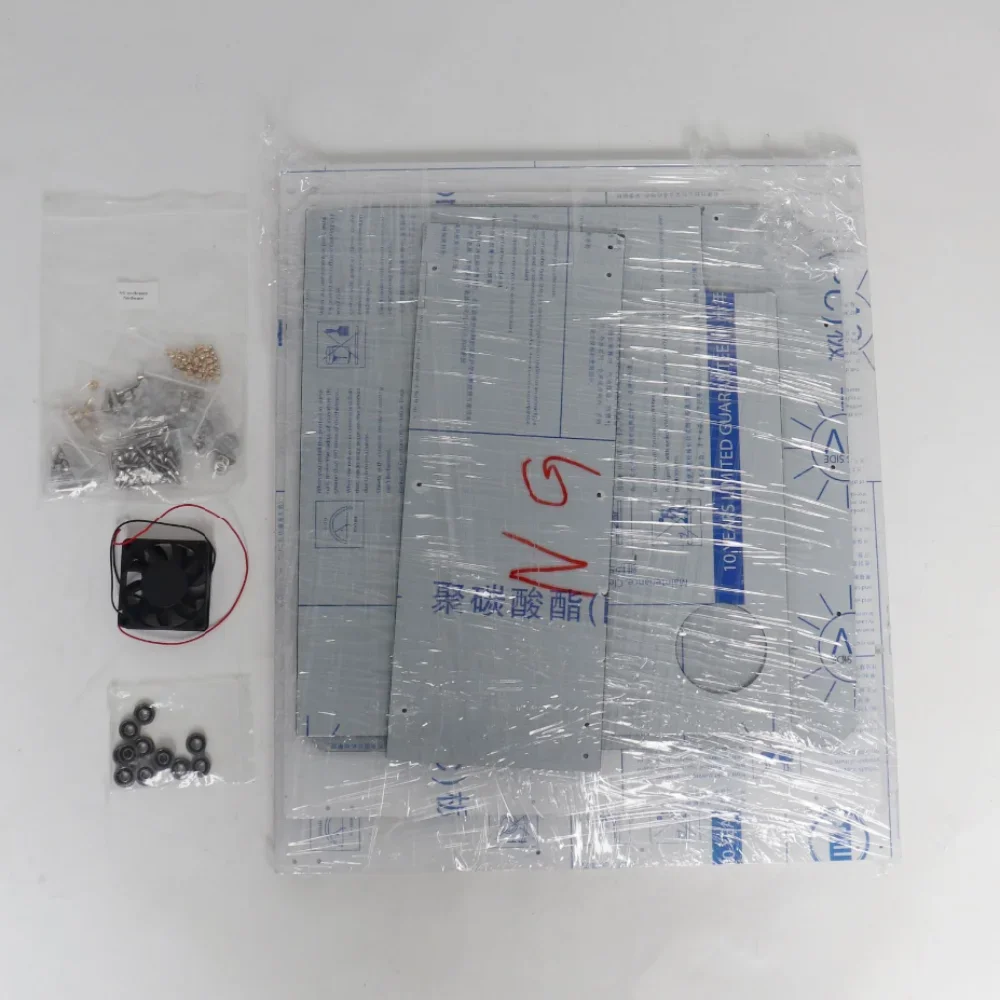
Funssor Ender 3 NG V1.2 Conversion Corexy 3D Printer Upgrade Enclosure PC Kit…
CoreXY Ecosystem Deep Dive: Full Kits, Conversions, and Core Electronics
Implementing a CoreXY platform spans three primary approaches: purchasing an assembled/semi-assembled open-source machine, engineering a DIY conversion from legacy Cartesian hardware, or sourcing a clean-sheet bespoke kit such as a Voron 2.4 or RatRig V-Core. Below is an engineering analysis of how the top-rated components fulfill these implementation tiers.
1. Turnkey Production Machines: The Sovol SV08 Architecture
The Sovol SV08 represents a significant milestone in democratizing open-source CoreXY mechanics. Drawing heavy structural inspiration from the Voron 2.4 design, the SV08 incorporates a flying gantry driven by four independent Z-axis leadscrew/stepper assemblies paired with a classic dual-motor CoreXY overhead belt system. This configuration eliminates bed drop and facilitates automatic Quad Gantry Leveling (QGL), compensating for structural non-planarities dynamically before initiating extrusion.
Operating under mainline Klipper firmware, the machine reaches rated linear velocities of up to 700 mm/s with accelerations exceeding 20,000 mm/s². The integration of a 300°C ceramic high-flow hotend satisfies volumetric requirements up to 35 mm³/s in standard PLA and PETG. However, stress testing reveals that reaching stable 700 mm/s motion requires fine-tuning belt tension balance to exactly 110–120 Hz across both loops to suppress high-order harmonic excitation at sharp vector transitions.
2. The Brain of Custom CoreXY: BIGTREETECH Octopus MAX EZ V1.0
For custom Voron, RatRig, or self-sourced CoreXY platforms, the central motion control board is the single most critical failure point. The BIGTREETECH Octopus MAX EZ V1.0 provides an ARM Cortex-M7 STM32H723ZET6 MCU running at 550 MHz, engineered specifically to manage the complex computational overhead of multi-axis synchronization, independent Z-leveling routines, and real-time step generation.
Featuring 10 EZ stepper driver slots with push-fit safety sockets, this board allows users to drive high-voltage TMC5160 Pro drivers at up to 48V for the primary A and B CoreXY motors, while running secondary Z-steppers and toolhead extruders at standard 24V. Operating the A/B motors at 48V provides substantial back-EMF headroom, enabling extreme acceleration profiles without the torque degradation typical of standard 24V systems operating at elevated RPM.
3. Converting Legacy Frames: Funssor Ender 3 NG Conversion Kit
For builders seeking to repurpose legacy aluminum extrusion platforms into enclosed high-velocity printers, the open-source "Ender 3 NG" project represents the bleeding edge of Cartesian-to-CoreXY transformation. The Funssor 4mm polycarbonate enclosure kit resolves one of the primary vulnerabilities of converted machines: thermal dissipation and structural draft control.
When transforming an open-frame V-slot bed-slinger into a CoreXY platform with linear rails, retaining ambient chamber temperatures between 45°C and 55°C is mandatory to prevent delamination when extruding ABS, ASA, or carbon-fiber composites. The 4mm CNC-machined polycarbonate panels provide high impact resistance, rigidity reinforcement for the outer extrusion frame, and acoustic dampening without adding dynamic mass to the motion assembly.
Mechanical Strengths and Engineering Trade-Offs
Kinematic Advantages
- Static Motor Mounts: Eliminating stepper motors from dynamic axes minimizes toolhead weight, allowing standard NEMA 17 or high-torque NEMA 14 pancake steppers to reach blistering linear accelerations.
- Planar Symmetrical Inertia: Equal moving mass along both the X and Y axes produces predictable, isotropic resonance patterns that Klipper's Input Shaping algorithms can clean up with minimal smoothing.
- Enclosure-Friendly Geometry: The cubic extrusion frame makes sealing the machine straightforward, enabling stable internal temperatures for engineering-grade filaments.
Mechanical Complexities and Challenges
- Coupled Belt Tension Sensitivity: If Belt Loop A and Belt Loop B deviate in tension by even 5–10 Hz, the toolhead will drift diagonally, introducing severe non-orthogonal skew into printed geometries.
- Gantry Racking Vulnerability: Misaligned idler pulleys, worn flanged bearings, or frame non-perpendicularity can cause the X-axis gantry to twist during fast direction reversals, binding linear guide rails.
- Lengthy Belt Paths: CoreXY belts are significantly longer than standard Cartesian belts (often exceeding 1.5 to 2 meters per loop). This length increases belt elasticity, requiring 9mm or high-modulus fiberglass/Kevlar-reinforced belts for large-format builds.
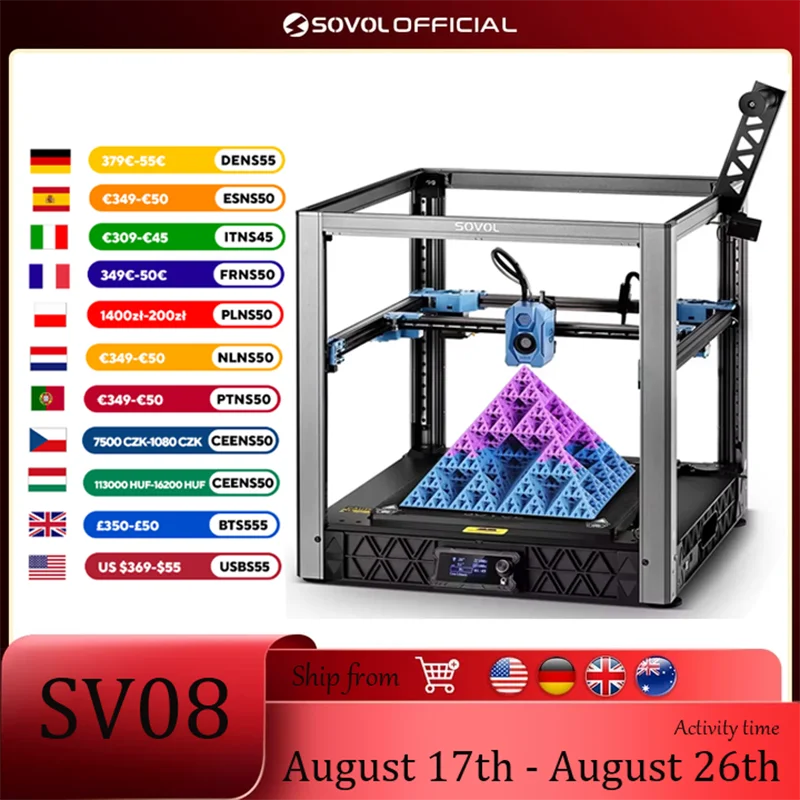
Sovol SV08 Core-XY 3D Printer Open Source, Max 700mm/s High Speed 3D Printers…
Assembly and Calibration Best Practices
Building or tuning a CoreXY 3D printer kit requires a methodical mechanical alignment process that differs substantially from standard Cartesian machines. Follow these engineering guidelines to maximize kinematic throughput:
1. Frame Squaring: Ensure the cubic aluminum extrusion frame is perfectly orthogonal. Measure corner-to-corner diagonals across all faces using precision calipers or a framing square. Any axial twist in the frame will propagate directly into gantry racking and premature wear on linear guide carriages.
2. Linear Rail De-greasing and Lubrication: Factory storage grease on budget linear rails increases viscous drag. Submerge rails in an isopropyl alcohol bath, dry thoroughly, and re-lubricate with synthetic grease (such as Mobilux EP2 or Super Lube synthetic grease with Syncolon) before installing carriages onto the gantry.
3. Belt Path Parallelism: Ensure all timing belts run completely parallel to their respective aluminum extrusion profiles across the entire sweep of travel. A belt that angles slightly inward or outward between idlers introduces dynamic tension variations, causing non-linear steps-per-millimeter across the build plate.
4. Input Shaping and Accelerometer Calibration: Mount an ADXL345 or KUSBA accelerometer directly to the toolhead carriage, then to the print bed (or flying gantry). Execute automated frequency sweeps (`SHAPER_CALIBRATE`) in Klipper to isolate the mechanical resonance peak of the frame. Select the recommended filter algorithm (typically MZV or EI) that provides maximum acceleration without aggressive corner smoothing.
Frequently Asked Questions
Why are CoreXY 3D printers faster than Cartesian bed-slingers?
CoreXY printers mount both heavy X and Y stepper motors permanently to the stationary outer frame, moving only a lightweight toolhead on the horizontal plane. Cartesian bed-slingers must physically accelerate the entire heated bed and print workpiece back and forth along the Y-axis. The dramatic reduction in moving mass on a CoreXY gantry minimizes inertia, allowing for accelerations of 10,000 to 30,000 mm/s² without triggering severe resonance, ringing, or motor stalling.
What is the difference between a Voron 2.4 flying gantry and a traditional CoreXY bed drop?
In a traditional CoreXY configuration (such as a Voron Trident or Ender 5), the horizontal CoreXY gantry is fixed rigidly at the top of the frame, and the heavy build platform drops down along the Z-axis as the print progresses. In a Voron 2.4 or Sovol SV08 configuration, the print bed is bolted immovably to the bottom of the frame, and the entire CoreXY gantry assembly is suspended by four independent Z-belts or leadscrews, moving upward and downward while automatically leveling itself via Quad Gantry Leveling (QGL).
Is it worth converting an Ender 3 to a CoreXY kit using the Ender 3 NG project?
Converting an Ender 3 using the Ender 3 NG open-source framework is highly worthwhile if you already possess the donor frame, power supply, and stepper motors, and want to learn advanced kinematics. It transforms an entry-level Cartesian machine into a high-speed, enclosed CoreXY printer capable of printing high-temperature materials like ABS and ASA at 300+ mm/s. However, if you do not enjoy sourcing individual hardware and printing structural PETG/ABS parts, a pre-engineered kit like the Sovol SV08 is more time-efficient.
Why do high-end CoreXY motherboards support 48V stepper motor input?
High-speed CoreXY motion requires stepper motors to rotate at high RPM. As motor velocity increases, back-electromotive force (back-EMF) opposes the supply voltage, causing motor torque to plummet rapidly at standard 24V operation. Running high-voltage stepper drivers (such as TMC5160) at 48V provides the necessary electrical potential to overcome back-EMF, maintaining high torque curves and preventing skipped steps at speeds exceeding 500 mm/s and accelerations beyond 20,000 mm/s².
How do you identify and fix belt tension mismatch on a CoreXY printer?
A belt tension mismatch on a CoreXY system manifests as dimensional inaccuracy on 45-degree diagonal movements, oval-shaped circles, or persistent ghosting along one axis. To fix this, loosen the motor mounts or belt tensioners, center the toolhead gantry in the middle of the frame, and use an acoustic frequency analyzer application on your smartphone. Pluck each belt loop over an identical unsupported span length and adjust the tensioning screws until both belt frequencies match within 1 to 2 Hz (typically targeting 110–120 Hz).
Related Articles
We focus on decision quality, not catalog volume.
Product Review
How to Choose a 3D Printer Extruder: Engineering Analysis & High-Speed Toolhead Guide
How to Choose a 3D Printer Extruder: Engineering Analysis & High-Speed Toolhead Guide Selecting the right extruder configuration represents the single most…
Product Review
CoreXY Upgrade Kit for Beginners Explained: The Engineering Guide
CoreXY Upgrade Kit for Beginners Explained: The Engineering Guide Converting a standard Cartesian bed-slinger into a synchronized CoreXY architecture is the sin…
Product Review
Types of Direct Drive 3D Extruders: Engineering Analysis and Motion Kinematics Guide
Types of Direct Drive 3D Extruders: Engineering Analysis and Motion Kinematics Guide Replacing a standard Bowden assembly with a direct drive extruder system re…
Featured Products on AliExpress

BIGTREETECH Octopus MAX EZ V1.0 BTT Motherboard Upgrade Octopus Pro 3D Printe…

Sovol SV08 Core-XY 3D Printer Open Source, Max 700mm/s High Speed 3D Printers…